Satchel Rosetta
CASE® (Competencies & Academic Standards Exchange) is a 1EdTech™ standard (like CLR, QTI, LTI) that allows organizations to publish learning standards
in a standardized, machine-readable format,
openly available via a standardized API,
where issuing agencies control the source of truth.
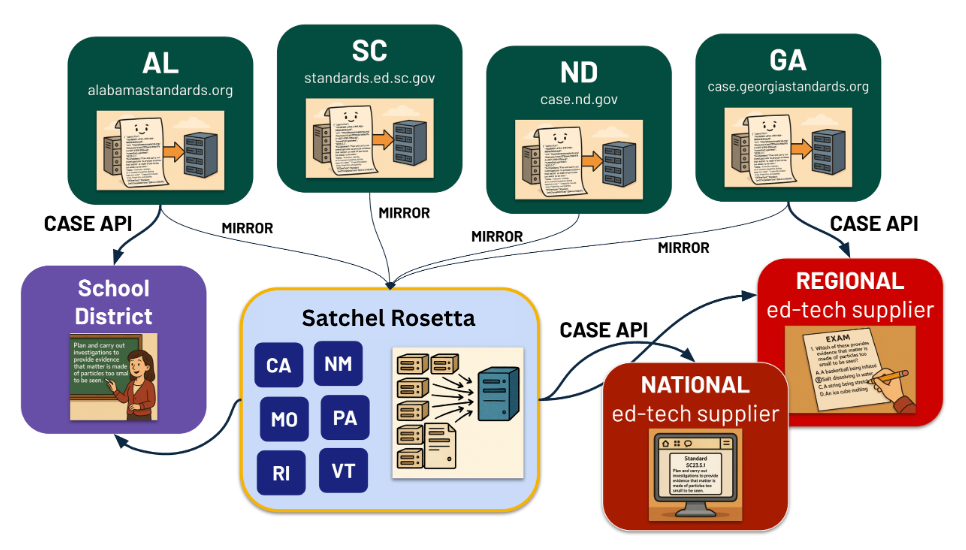
As of June 2025, 20 US states, as well as other agencies such as Chicago Public Schools, WIDA, and the College Board, are publishing standards on their own CASE® servers. The majority of these agencies use Satchel as their CASE® publishing tool.
Since 2023, CGLT has grown the number of frameworks available in CASE by serving as the CASE publisher of a total of 9 core subject areas for all states not yet publishing in CASE, updating frameworks when new sets are adopted, and gathering frameworks from other CASE publishers for ease of access. As of 2025, CGLT has taken on CASE publishing for international frameworks for the core 4 subjects.
Satchel Rosetta is Common Good Learning Tools way to give back to the edtech ecosystem while also supporting interoperability. This product and our services are funded by an annual subscription fee charged to the edtech, curriculum, and assessment suppliers using the CASE data for their commercial products. Some suppliers like Google, Frog Street, Star Autism, Carnegie Learning, and Powerschool also sponsor the initial conversion of additional CASE frameworks which we also maintain to help grow the reach of CASE!
The CASE® Ecosystem
How can I take advantage of the CASE® Ecosystem?
Educators, Schools, and Districts
Satchel Rosetta can be accessed, at no cost and without registration by anyone interested in unlimited browsing, simple printing, and basic exporting.
Some organizations like Infinite Campus, Google Classroom, and Frog Street are already helping educators and systems leaders to make the CASE® formatted data available in Satchel Rosetta visible within their products without the need for import.
Many other registered suppliers, like Powerschool, have improved their import options to allow systems leaders to use CASE as a starting point to re-format CSV files from Satchel Rosetta to set up courses, grade books, report cards, assessments, and more.
While 20 states have championed the CASE® movement and adopted tools like Satchel to host these interoperable versions of their competencies and standards, we still have more states and organizations to go. Our goal, along with many of the registered contributors to Satchel Rosetta, is to enable every issuing agency to self-publish, ensuring the accuracy and up-to-date nature of their CASE® data.
To help us bring CASE® to your state, district or other not-for-profit institution, CGLT provides three options:
Dedicated Satchel hosting: For $24,000 per year, you can secure your own dedicated server with a branded instance of Satchel, our CASE® publishing tool. This option gives you full control over all aspects of CASE data management, as well as access to Satchel’s alignment and cross-walking tools, detailed in the ed-tech suppliers section.
Shared Satchel hosting: For $6,000 per year, you can use a “patch” on Satchel Commons, also a CASE® publishing tool where your frameworks will be hosted on a shared-tenancy server alongside other states, districts, and agencies. This is an excellent option for organizations that want to start with CASE but don't have the budget for a dedicated instance.
Satchel Rosetta services only: No annual subscription is required for this option. CGLT can cover the basic costs of publishing and maintaining various standards frameworks and hosting them via Satchel Rosetta through revenue collected from registered suppliers who use the service. Agencies that do not host their own CASE® frameworks can partner with CGLT, at no cost, to ensure that the already published frameworks are reliable sources for their agency’s standards.
If you choose either of the first two options, CGLT will work with you to adapt the frameworks already published for use as the “official” CASE® frameworks for your agency, at no additional cost. Additionally, if you want to create and publish new frameworks, we can either provide training for your team to use Satchel’s edit and review tools to become CASE® publishers, or we can handle the initial coding for you for a fee.
A table listing detailed differences between these three options is available here.
If you are part of a school district or other agency in a state that is not yet self-publishing in CASE®, we would be delighted to collaborate with you!


Ed-Tech Suppliers
Using Satchel Rosetta as your Skills Database
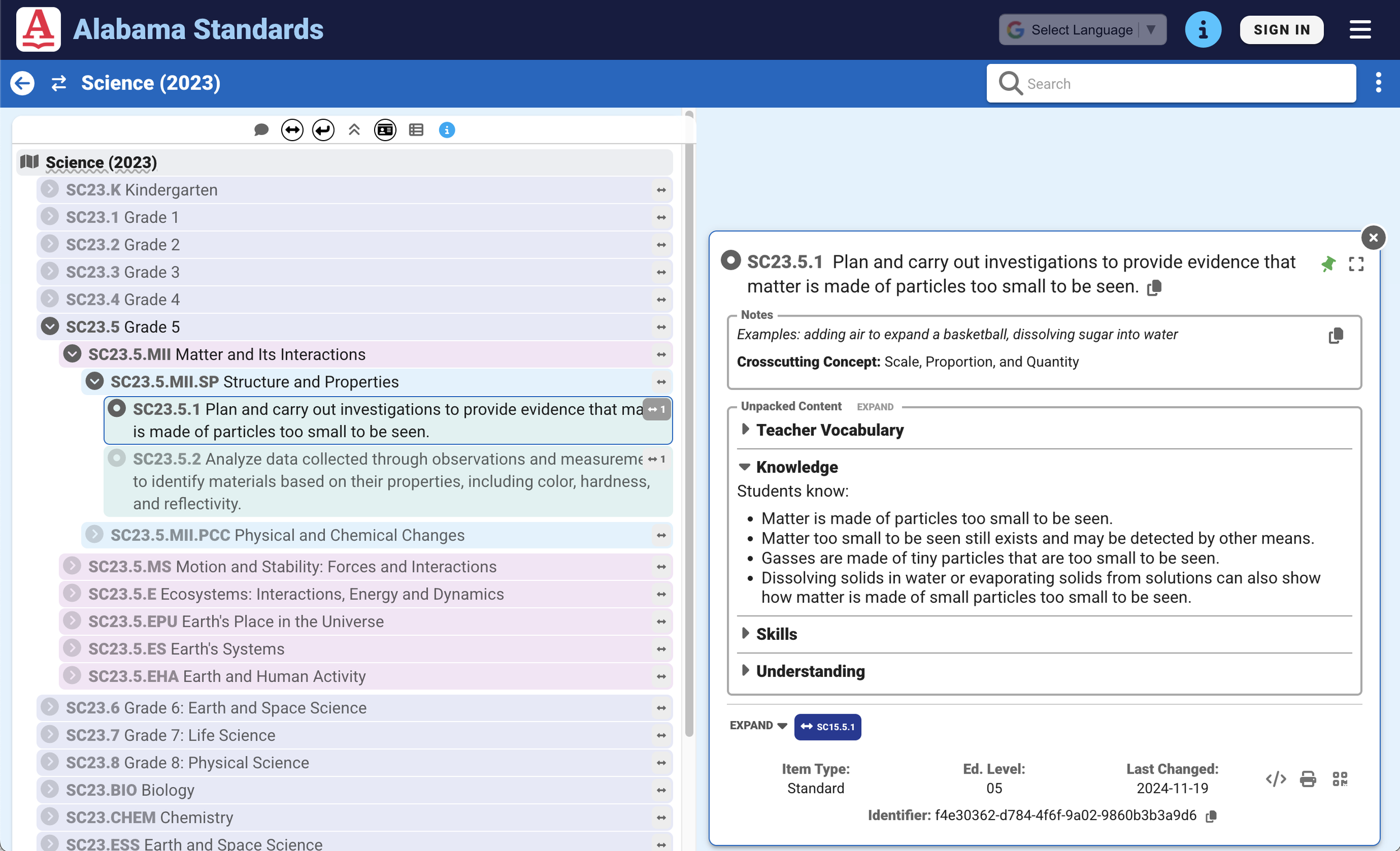
Access up-to-date frameworks for at least 9 core subject areas (ELA, Math, Science, Social Studies, Computer Science, World Languages, Health, Physical Education, and Early Learning) from all 50 states (plus DC, Puerto Rico, and many other agencies) in standard CASE® format, via the CASE API, from Satchel Rosetta.
Satchel Rosetta also includes additional services, such as:
Update reports and weekly email notifications for frameworks that have been updated (info. also available via API).
The GUID Translator tool, which helps with migrating to CASE® from alternative codings of standards
Sanitized versions of the CASE® 1.0 and 1.1 APIs that remove html and other non-conformant data from CASE® JSON
An API to access LLM vector encodings of any subject framework from any state (Satchel uses these for advanced search, association, cross-walking, and alignment services; you can use them however you wish!)
To help cover the expenses associated with developing, managing, maintaining, and continuously enhancing the CASE® data and services we offer, CGLT requires suppliers to pay an annual subscription fee of $10,000. This fee grants unlimited access to the Satchel Rosetta APIs and all data. For more details, please refer to the CGLT terms of use.
Using Satchel Rosetta Alignment Tools
Rosetta Alignment pairs CASE® data with AI suggestions to streamline the process of aligning and “cross-aligning” resources to learning standards. Our system uses LLM vector encodings of standards and resource metadata to make suggestions for initial alignments; your SME reviews these suggestions and creates alignments with a click of a button. To then align to a new framework, Rosetta Alignment uses the LLM encodings to generate an “auto-crosswalk” between the standards in the initial and new frameworks, and uses the auto-crosswalk in addition to the resource metadata when making suggestions. As you cross-align to each additional framework, Rosetta’s suggestions keep getting more and more accurate.
Try Rosetta Alignment for a one-time $1K pilot fee; if it works for your company’s needs, yearly access to Rosetta is $25K, which includes the registration fee mentioned above and allows you to create as many alignments to as many states, frameworks, and items as you wish.
Using Standards Satchel as your Skill Spine Builder or Crosswalk Library
If your company manages your own frameworks, skill spine, crosswalks, or has needs for other metadata management functions, you can license your own instance of Standards Satchel from CGLT. The cost for ed-tech suppliers is $50K/year, which includes full access to all our Satchel features including all CASE mirrors, the alignment tools, and framework authoring features that states / issuing agencies access as described above.
Ask us about discounts for your first year of access to any of these services.