Standards Satchel
The CASE® Ecosystem
Competencies and Academic Standards Exchange (CASE®) is a set of guidelines published and maintained by 1EdTech™:
The CASE information model specifies how to encode competencies (e.g. learning standards), associations between competencies, and competency frameworks (i.e., collections of competencies and associations) in a standardized JSON format.
CASE also defines a standardized set of APIs that allow any CASE consumer to retrieve CASE-formatted JSON describing competencies, associations, or frameworks from any CASE publisher.
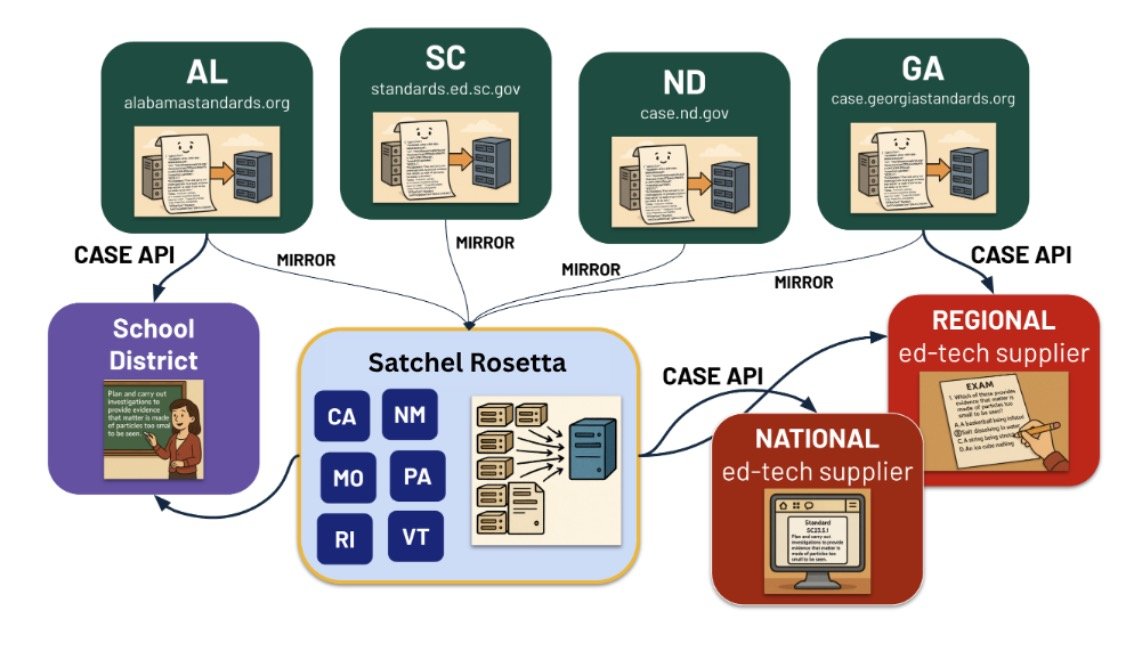
These two specifications, along with best practices developed by the CASE community, establish the CASE ecosystem: an interconnected network of server nodes that allow each issuing agency to control the source of truth for their competencies, but facilitate the sharing of those competencies in a standardized machine-readable format across all digital systems that choose to “plug in” to the ecosystem.
CGLT is the leading provider of
products and services for publishing, managing, and utilizing CASE-coded learning standards.
For standards issuing agencies, including state or country DOEs, school districts, universities, and non-governmental agencies:
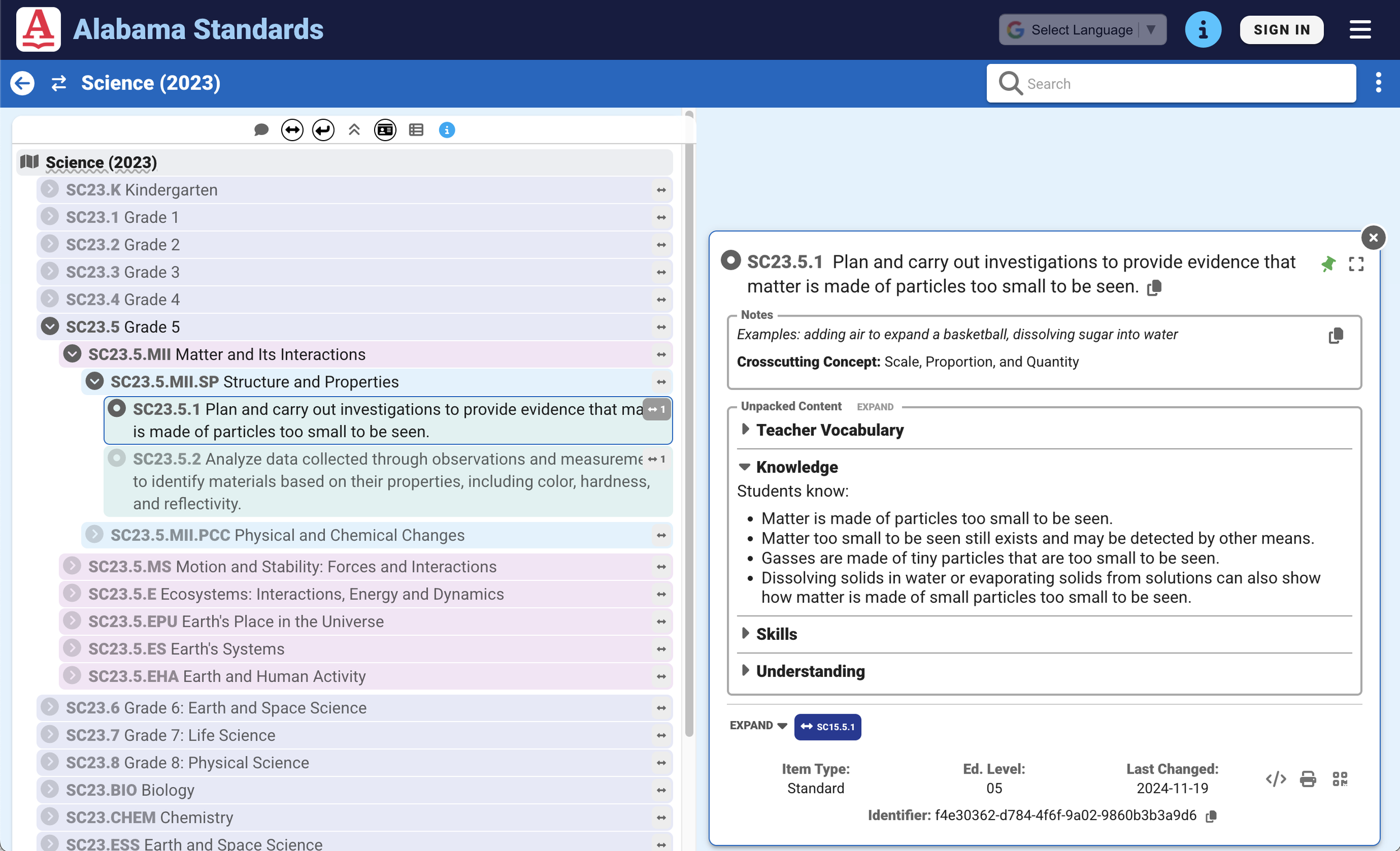
Our Standards Satchel web application is the premier CASE-based Competency Management platform. Your organization can use Satchel to publish CASE frameworks via:
A dedicated webserver instance of Satchel that you fully control
A “patch” of Satchel Commons, our shared hosting platform
Satchel Rosetta Exchange (see below)
We also provide services around “coding” standards frameworks in CASE format, starting from almost any other format, including PDFs, Word or Google Docs, and spreadsheets.
For ed-tech companies that want to make use of CASE frameworks in their products:
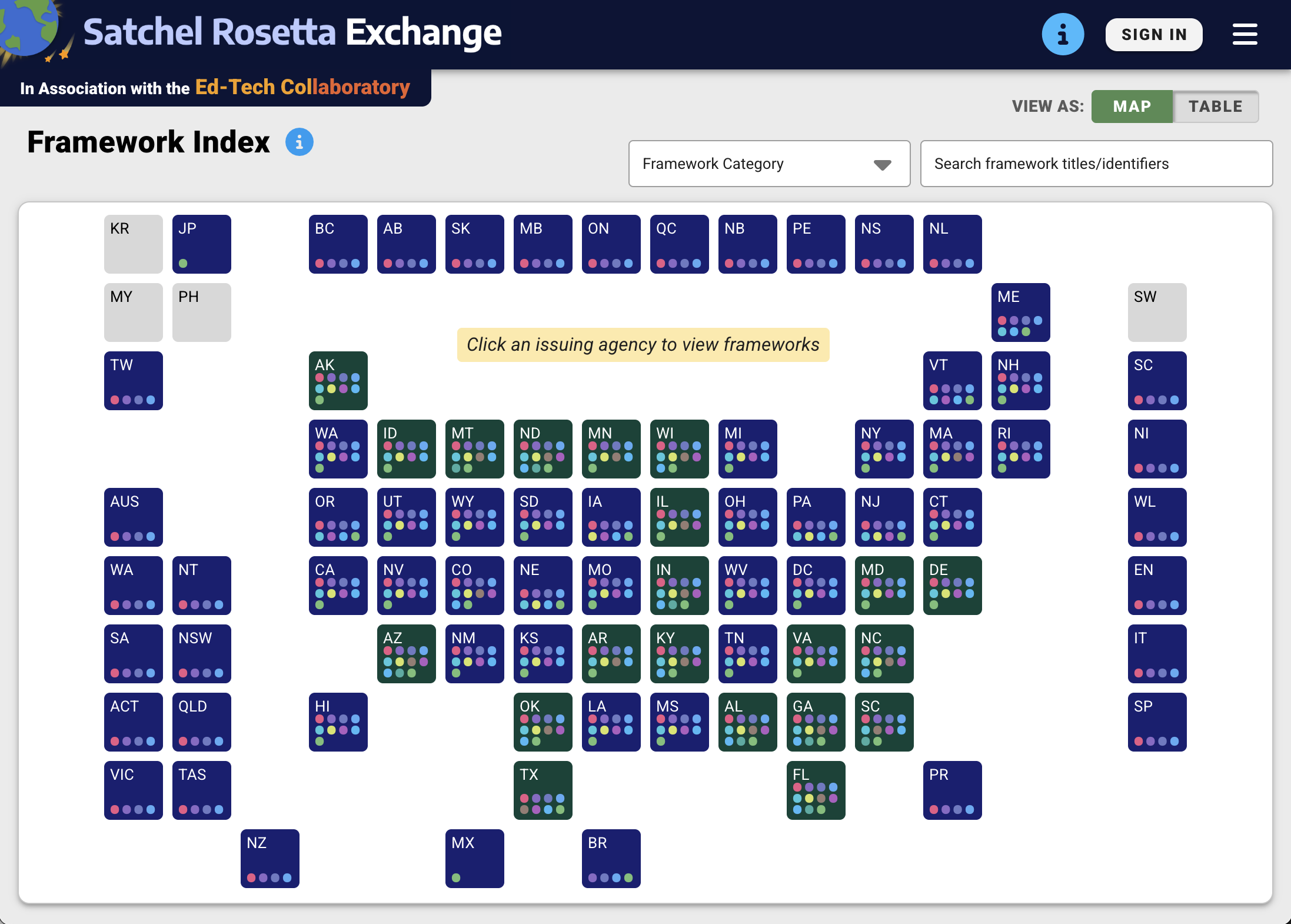
We built, host, and maintain Satchel Rosetta Exchange, a central repository of CASE-coded standards frameworks from across the US and around the world, which can serve as a low-cost standards database for your company.
Our Satchel Rosetta Align system provides functionality assisting companies with the process of aligning teaching and learning resources to standards, including “cross-aligning” resources that were originally designed for one agency’s framework to other agencies’ standards.
Companies can also license their own instance of Standards Satchel to create and manage their own competency frameworks, including “crosswalks” and “skill spines.”
Agencies Take Charge with CASE® — A Trusted Source of Truth
If you want your agency’s standards or competencies converted into machine readable CASE format, your organization can (1) jump into hosting your own dedicated Satchel server with ongoing CGLT guidance, (2) ease into a shared hosting instance with a free patch on Satchel Commons, or (3) get a quote for our CASE conversion services to convert the documents (typically $500-1500 per PK-12+ subject area) and host them on Satchel Rosetta Exchange. Learn more about your options below:
-
Issuing Agencies like states or ministries of education choose this option when they plan to leverage the full suite of Standards Satchel features and integration options available for CASE. Dedicated Satchel hosting provides System Admin level user management, SSO options, unlmited framework creation with crosswalks, and features to manage the full life cycle of a framework. Product features related to drafting private frameworks, managing sandboxes, using a public comment process, tracking changes through revisions, creating comment groups for reviewers, adding learning progressions or crosswalks, and even including supplemental information are all available. A dedicated hosting plan for a Standards Satchel instance costs $24k / year for public agencies; for ed-tech companies, the cost varies depending on what you plan to use Satchel for, but is on the order of $50k / year.
Both public and private partners that license Satchel receive:
Dedicated hosting on an AWS cloud server or on a server hosted by the organization; in either case CGLT does all the work of deploying and maintaining Satchel on the server
Branding and customization options for the Standards Satchel instance
All Satchel’s tools for CASE publishing from scratch, from an import, or with our paid services
Unlimited access to Satchel Rosetta Exchange to mirror frameworks and crosswalk
Unlimited access to Rosetta Align (or the Rosetta Align API, if preferred)
More options for custom development to…
Embed the Satchel UI as an iframe into other applications
Access the Standard Satchel API or Rosetta Align API services for other applications
Integrate with identity management systems for SSO
Create specialized export formats for applications and systems you rely on
Public agencies currently licensing dedicated Satchel instances include:
Alabama DOE
Arizona DOE
Chicago Public Schools
Georgia DOE
Gwinnett County Public Schools
Idaho DOE
Montana DPI
North Carolina DPI
Oklahoma DOE
South Carolina DOE
Wisconsin DPI
Companies and non-public organizations currently licensing dedicated Satchel instances include:
Carnegie Learning
The College Board
Edsby
Frog Street
WIDA (Wisconsin Center for Educational Research)
-
Issuing Agencies (states, ministries of education, districts, and even schools) sometimes start with this option to get CASE off the ground or if they have a couple of eager departments or teams ready to jump into CASE. This plan relies on CGLT to act as the System Admin for a shared instance of Satchel and designate select Framework-level admins to manage the work. Basic authoring and editing tools are available with this plan as well as some options to make associations from one framework to another.
A shared hosting plan for Satchel Commons costs $6k / year and includes:
Shared hosting on Satchel Commons with limited branding options.
Many of Satchel’s authoring tools for CASE publishing - creating frameworks, managing reviews with comments, tracking changes, archiving, etc.
Some framework mirrors from Satchel Rosetta Exchange are allowed for making associations from one framework to another.
Access to shared hosting on Satchel Commons includes up to 5 hours of online training per year and additional framework specific consultation with the purchase of CASE conversion services if needed.
Public agencies currently licensing a shared instance of Satchel Commons include:
Columbia County School District
Delaware DOE
Henry County Schools
Kentucky DOE
Prince Williams County Schools
Virginia DOE
**NOTE: There’s also an option for a FREE Satchel Commons Patch. This allows one user to create a patch and author up to five frameworks. To register and get started with our User Guides, visit https://satchelcommons.com/.
-
Some organizations simply need fast access to machine-readable versions of their documents but are not yet prepared or interested in taking on the role of CASE publisher. In these situations, CGLT serves as the CASE publisher and offers our services for CASE conversion which range from $500 for a K-12 framework up to $2500 for a complex framework with learning progressions, crosswalks, and supplemental information added. This is an ideal option if your organization needs only one or two documents converted to CASE with a short timeline of 2-3 weeks.
The quickest way to find out the exact cost for a conversion is to email support@commongoodlt.com with a link to the source document, a PDF, or a spreadsheet and ask for a quote.
We will likely offer to schedule a free CASE consultation to briefly talk through how we've coded similar frameworks and to better understand your goals for using CASE. We can give you a timeline and quote during the meeting.
Take a look at Satchel Rosetta Exchange to get ideas for what you might want out of your CASE conversion.
Machine-Readable Formats Support Accessibility
Publishing state learning competencies in Satchel's machine-readable CASE® format directly supports accessibility goals by moving content out of static PDFs, which are notoriously difficult for screen readers and assistive technologies to interpret correctly, and into structured, web-based data that can be consumed by other applications. Because the CASE API delivers competency data as clean, structured text, ed-tech tools and platforms that are themselves Section 508-compliant can also more reliably display and navigate that content for users of all abilities. This reduces the burden on agencies to maintain separately formatted accessible versions of their documents, since the machine-readable format serves as a single interoperable source of truth.


Ed-Tech Companies and Nonprofits Lead with CASE® & Interoperability
Satchel Rosetta Exchange
A fundamental principle of the CASE ecosystem is that the original creator of any collection of competencies should be publishing the CASE framework representing those competencies. However, many CASE Consumers need data from many different competency issuing agencies (e.g. all 50 US states), and keeping track of the server locations where each of these agencies’ frameworks are published can be challenging. Furthermore, many issuing agencies currently lack either the funding or the awareness to be currently publishing their standards in CASE.
Satchel Rosetta Exchange facilitates the use of CASE by addressing these two issues:
Rosetta Exchange starts by mirroring frameworks from all known issuing agencies that are publishing CASE frameworks themselves.
CGLT then “fills in the gaps” by publishing and maintaining CASE representations of the latest frameworks from many other agencies.
Consumers can then retrieve frameworks from all these agencies from a single web location and/or a single API location.
CGLT operates Rosetta Exchange as a public benefit project to the broader ed-tech ecosystem, in association with the Ed-Tech Collaboratory.
To support our work of aggregating and maintaining CASE frameworks, we ask ed-tech companies that use Rosetta as their database for standards to contribute a maintenance fee of $8,400/year to CGLT. Organizations that make this contribution receive:
Unlimited access to standards from all 50 US states, plus many NGOs and a growing list of other countries, via the Rosetta CASE API or via various download options (we also offer a Core-4 plan for $6k/year as well as a 1-month trial for $500 for 40 frameworks)
Access to Rosetta’s “normalized” API that corrects for CASE best-practice violations
Automated notifications when standards frameworks are updated
Consultative services from CGLT around using CASE
The funding we receive from registered organizations allows CGLT to provide free access and exports to educators and public agencies.
Satchel Rosetta Align
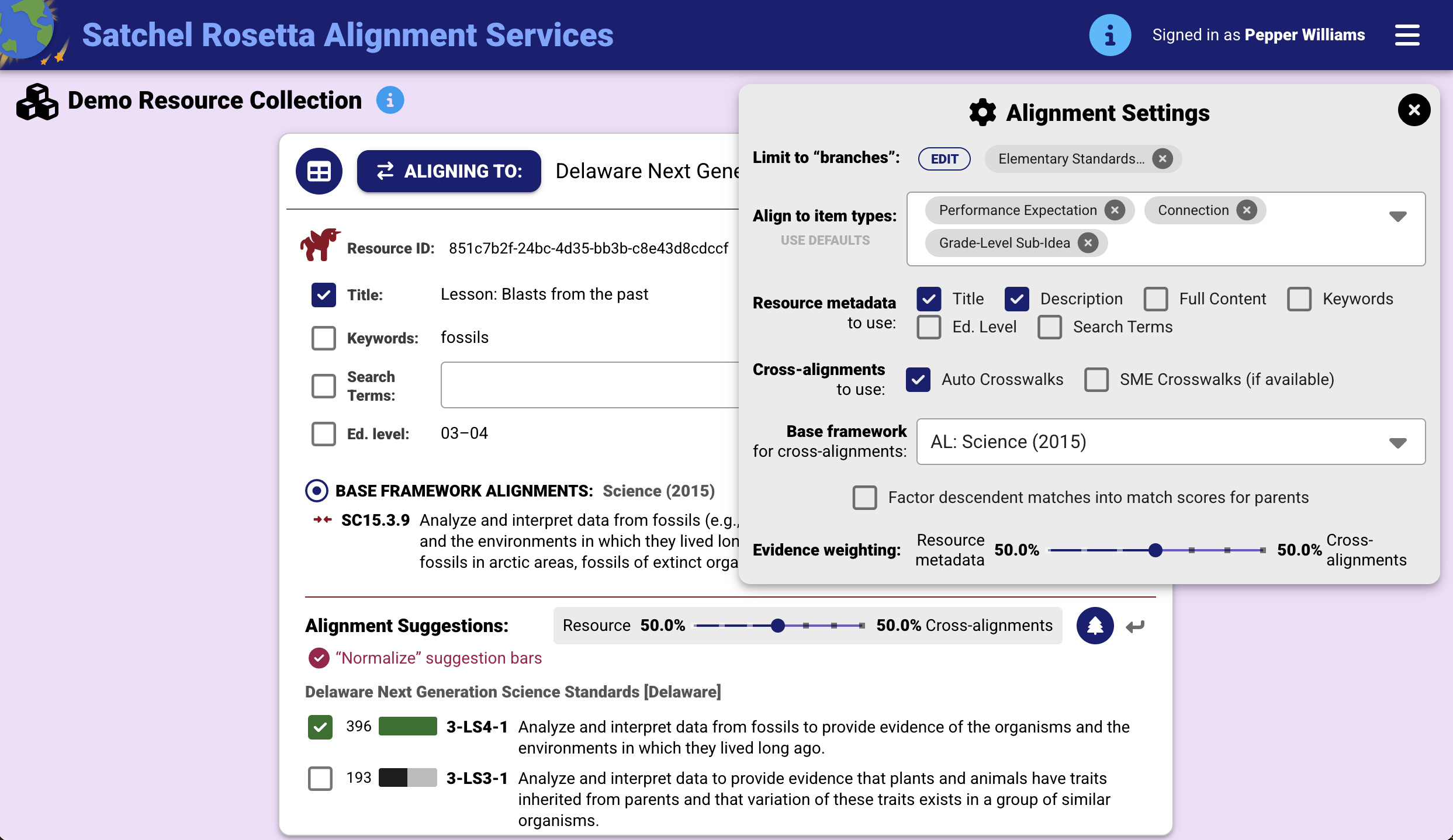
Satchel Rosetta Align leverages CASE data and LLM tooling to streamline the process of aligning and “cross-aligning” resources to learning standards. We offer two variants of this functionality:
The Satchel Rosetta Align platform uses vector encodings of standards and resource metadata to compute objective measures of resource-standard similarities that serve as suggestions for alignments. The user interface (UI) allows a subject matter expert (SME) to review these suggestions and create alignments with the click of a button; you then batch-export these alignments for import into your system. If your resources are already aligned to one framework (e.g. Common Core), the platform can use LLM encodings to generate an “auto-crosswalk” between the standards in the initial and new frameworks, and use the auto-crosswalk in addition to the resource metadata when making suggestions.
The Satchel Rosetta Align API allows you to compute alignment suggestions for any set of resources to any set of standards using a single API call, using the same LLM-powered comparison algorithms used in the Satchel Rosetta Align UI.
CGLT can also work with you to develop bespoke hybrid processes tailored to your alignment needs. For example, we are working on a tool allowing a publisher to upload PDFs of textbook chapters, choose a subject framework, and receive an automatically-generated “Suggested Alignment Report” that shows sections of the textbook that best align to each of the standards in the framework.
Access to Satchel Rosetta Align is billed on an annual basis; you can use the system to make as many alignments as you wish for however long you choose to license the system. The annual cost varies depending on your organization’s needs, and starts at $15k/year, including unlimited access to Satchel Rosetta Exchange.