Realignment at Scale: When CASE® Meets AI in Alabama
When academic standards change, State Departments of Education, EdTech companies, and content providers face a familiar, and costly, problem: realigning hundreds or thousands of existing resources for teaching and learning to a new framework. Alabama's ALEX Learning Object Repository (Cureum) offers a better model.
By leveraging CASE®-managed standards as structured data, AI-assisted suggestions, and a human in the loop, the built-in Satchel Rosetta Align tool automates re-alignment at scale. See a demonstration of the process and tool Alabama uses to streamline their arduous summer process that involved a small army of subject matter experts (and too many spreadsheets) down to a few hours of work completed by one staff member all before the end of the school year!
Learn more: alabamalearningexchange.org #ALEX #CASEFramework #EdTech #StandardsAlignment
The Impact of Adopting New Standards
Every few years, it happens. A state revises its academic standards framework. A new set of learning progressions is adopted. And suddenly, all your assessment items, countless lesson plans, curated instructional videos… years of carefully developed, rigorously aligned content… needs to be realigned. Again.
For most organizations, that has meant marshaling subject matter experts, spinning up spreadsheets, and grinding through a manual crosswalk process that consumes enormous time, budget, and institutional energy. But a new approach, already rolled out in Alabama, is showing what's possible when standards are treated as structured, connected data rather than static documents.
The Hidden Cost of Standards Transitions
When a new standards framework is adopted, the challenge isn't simply understanding the new standards, it's reconnecting existing content to them. Districts, state agencies, and EdTech providers often hold hundreds or thousands of resources aligned to previous frameworks. Letting that work go to waste isn't an option, but the traditional realignment process has been slow and expensive by design.
Subject matter experts have had to manually crosswalk old standards to new ones, resource by resource, standard by standard, often managing the whole effort through spreadsheets and fragmented workflows. The result: delayed access to quality content for teachers at exactly the moment they need it most - when implementing new standards in their classrooms.
There's a better way.
CASE: Standards as Structured, Machine-Readable Data
The foundation of Alabama's approach is CASE (Competencies and Academic Standards Exchange), a set of guidelines for encoding structured, machine-readable data with defined relationships between standards.
That distinction matters enormously for EdTech organizations. When standards are just documents, every transition requires human effort to re-interpret and re-connect. When standards are structured data with explicit associations, capturing how old standards map to new ones, how learning progressions evolve, how concepts connect across grade levels, those relationships become the infrastructure for automated workflows.
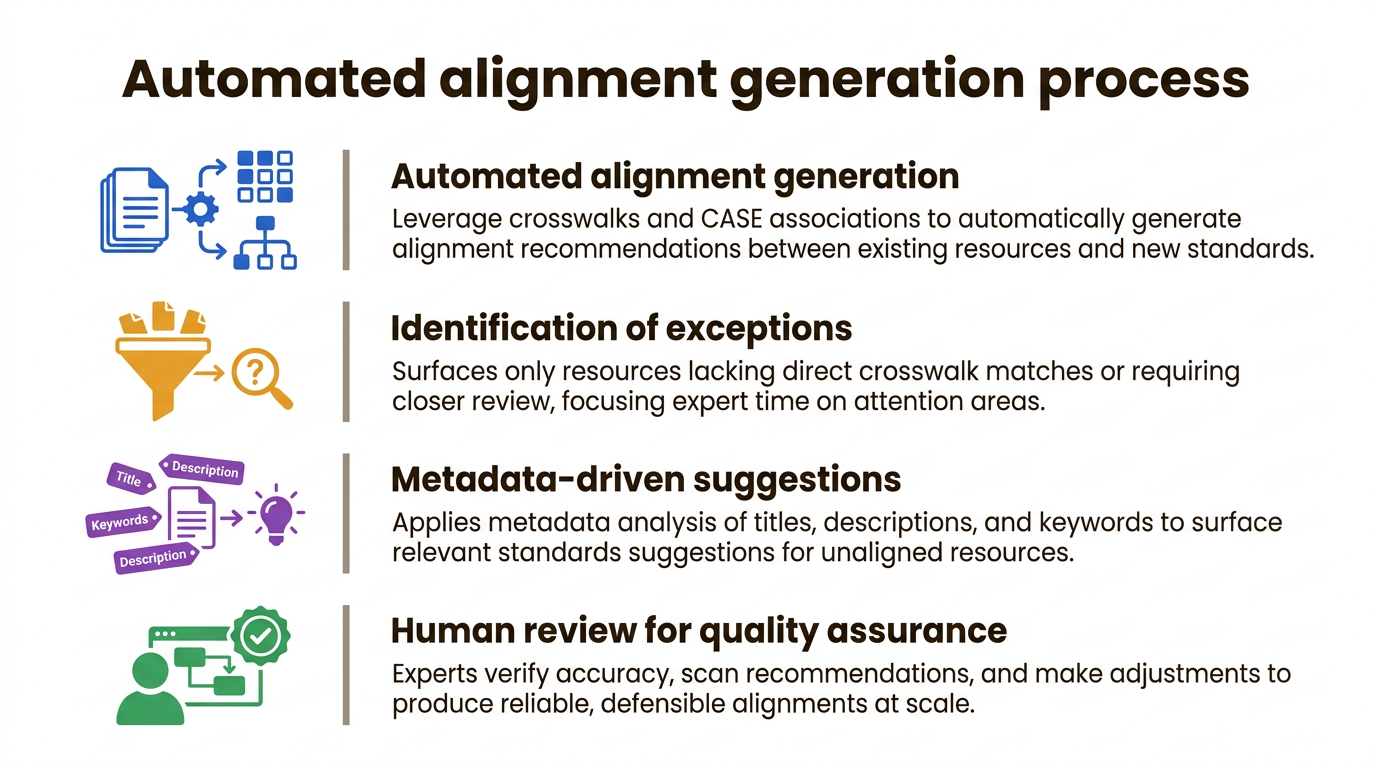
In Alabama, subject matter experts develop crosswalks between previous and new standards frameworks, which are then encoded as CASE associations. These associations preserve learning progressions and create the metadata for automated alignment recommendations at scale.
The Rosetta Realignment Tool: Automation Meets Expert Review
Built on Alabama's CASE-encoded standards, the Satchel Rosetta Align system integrated into the ALEX Learning Object Repository (Cureum) demonstrates what large-scale realignment looks like when standards data is doing the heavy lifting.
What This Means for States & EdTechs
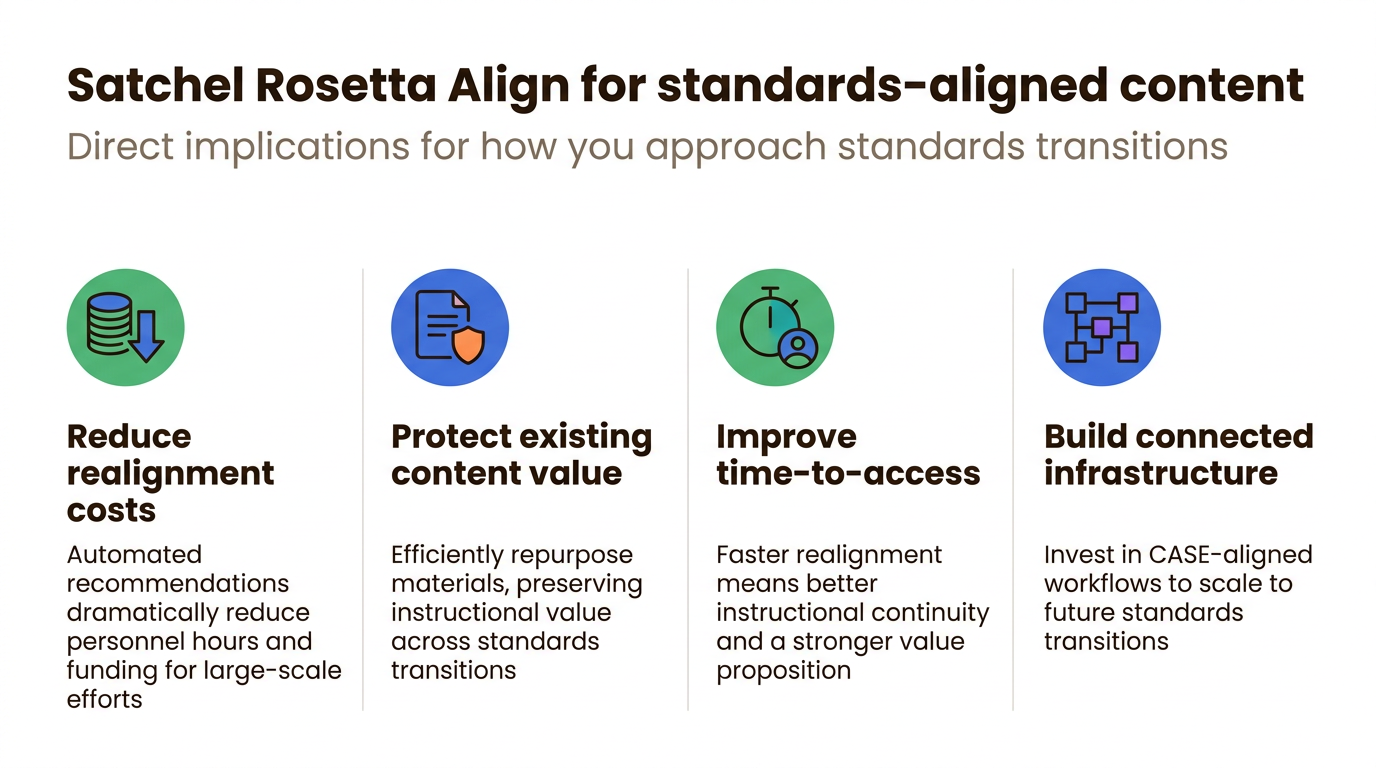
If your organization produces or manages standards-aligned content, whether that's assessment items, instructional videos, lesson plans, or full curriculum units, the Satchel Rosetta Align system has direct implications for how you approach standards transitions.
The Bigger Picture
The ALEX implementation is a working proof of concept for an industry-wide shift: from managing standards as isolated documents to leveraging them as connected, reusable data assets.
Moving beyond static PDFs to structured standards data doesn't just streamline alignment workflows, it changes what's possible. Automated recommendations, cross-framework associations, metadata-driven discovery, and scalable quality review workflows all become achievable when standards are treated as the structured data they can be.
For EdTech companies and content providers navigating an environment of frequent standards change, this isn't a nice-to-have. It's a competitive and operational imperative.
Explore the ALEX Learning Object Repository alabamalearningexchange.org or visit Alabama’s CASE® publishing tool https://alabamastandards.org/ to see what’s possible!
